
Introduction
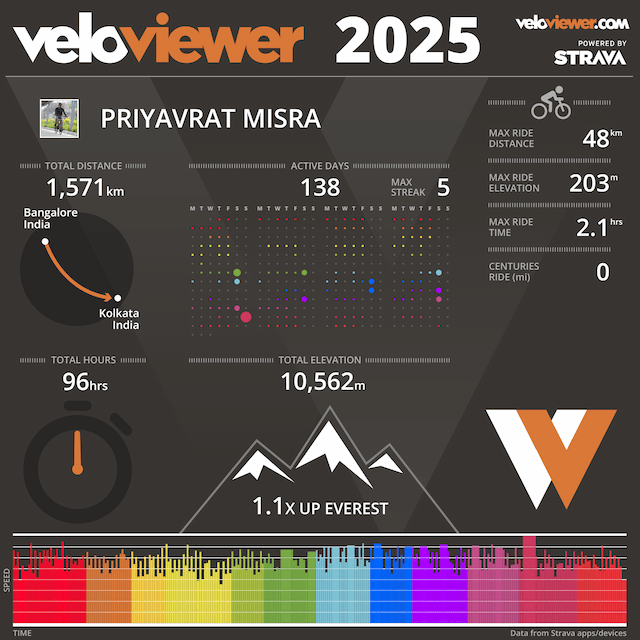
I just reached a personal milestone: 500 days of pedaling to work. It is funny how things turn out. If you had asked me when I started three years ago, I never would have guessed I’d make it this far.
It all began quite humbly. I had just landed my first job, and my new office was only five kilometers away. It felt like a reasonable distance to cover on a cycle, so I used my very first paycheck to buy a hybrid cycle. Obviously there were skeptics. Some told me that commuting would lose its charm after a few weeks. Others warned that I would eventually grow weary of being late or getting caught in the heat. I chose to ignore the noise. I wanted to prove them wrong, not with words, but with consistency. Even on the mornings when I did run late, I refused to blame the bike. Instead, I’d just wonder how I could have managed my morning routine a little better.
A Childhood Dream
In truth, much of my decision to buy that bike was rooted in my childhood. Back then, cycling was my primary mode of freedom. After school, a group of us would pedal together to our coaching classes. This was a time before the digital world took over. In every neighborhood, there was always that one legendary tutor. Their house would have a faded poster out front boasting titles like “Gold Medalist in Math” or “Ex-IITian.” We didn’t have Google reviews to guide us. We relied on word of mouth and the blind faith of our parents. Then there were the school teachers who tutored in the evenings. They didn’t need posters. We flocked to them because their practice questions were like gold dust; they almost always ended up on the final exams. We were suckers for a good spoiler.
The best part of the day was racing from one class to the next. We often had three sessions back-to-back with approximately thirty-minute gaps in between. Since we didn’t have smartphones to distract us, our only entertainment was trying to outpace one another. We would arrive at class drenched in sweat and out of breath, but it didn’t matter. What mattered was who crossed the “finish speed bump” first. I remember having a sort of F1-level dedication back then, constantly oiling my chain and checking my tire pressure before heading out. It was a wonderful time to be alive.
Most of us rode simple, single-gear cycles. We were fiercely jealous of the few “rich kids” who had geared bikes. We used to think that more gears automatically meant more speed. I always dreamt that when I grow up, I will own a geared bike. But as we got older, life got in the way. The world changed. Cheap internet and online resources made those rides unnecessary. Our bikes began to collect dust in dark corners of the garage.
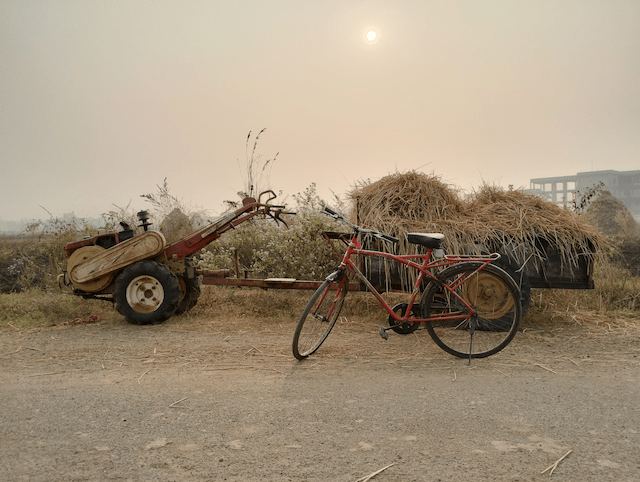
A recent ride proved that while the bike has aged, the muscle memory remains as sharp as ever.
The Origins
Nearly six years passed before I sat on a bicycle seat again. I suppose that childhood dream of owning a geared bike was still lingering in the back of my mind when I walked into the shop in February 2023.
Once I started, the habit took hold quickly. The ride to the office only took ten to twenty minutes. I often arrived earlier than my colleagues who drove because I could easily navigate through traffic or take the occasional shortcut on the footpath. It became the perfect way to start my day. A bit of leg stretching and a change of scenery was the ideal antidote to a day spent staring at computer screens.
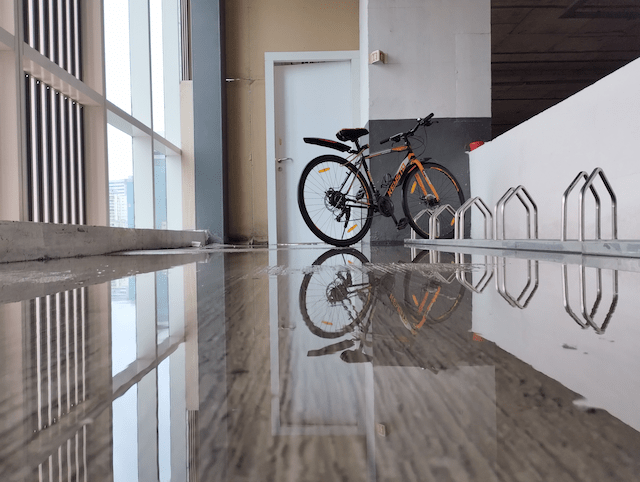
The momentum shifted when my current employer, ADP, started a cycling club. I met “serious” cyclists who thought nothing of riding hundreds of kilometers in a single trip. At first, that sounded like madness to me. I was perfectly content with my ten kilometers a day. But curiosity is a powerful thing and on top of that India’s largest solar-roofed cycling track, a beautiful 22.5 kilometer stretch, started right next to our office. I spent months looking at it from our office windows until I finally decided to give it a go.
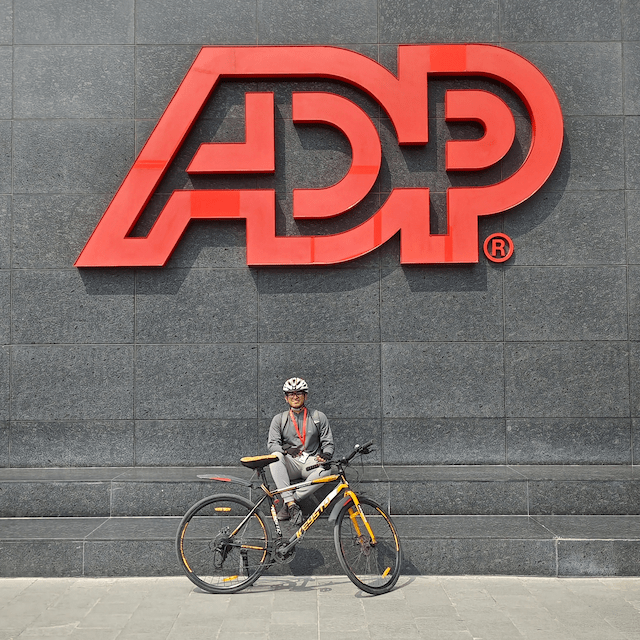
I asked a friend for a quick shot in front of the ADP logo, and he immediately assumed I was handing in my resignation.
On a fine Saturday in February 2024, exactly one year after buying my bike, I headed out to the track. The autumn air was crisp and soothing. The track was perfect, with no bumps or traffic signals, just leading lines stretching toward the horizon. I cycled 42 kilometers that day. Without even trying, I had picked up a new habit. For the first time in years, I felt like that kid racing to coaching class again.
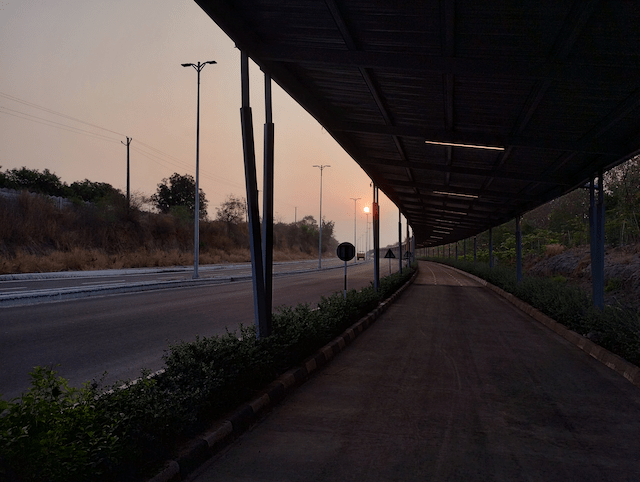
I stopped here to appreciate the leading lines of the solar-roofed track and the morning glow; definitely not because my legs were screaming for a break.
The following ride, I covered the entire track, pedaling a total of 53 kilometers. Every Saturday became a personal challenge to beat my previous time. Occasionally, people from work would join me, and sometimes I would make a friend or two among the strangers along the track.
Keeping Track
To keep track of these long rides, and to be a bit privacy conscious, I used a local-first, open-source fitness app called Fitotrack. While I logged those weekend excursions, it wasn’t until Day 299 that I realized I should have been tracking my daily commutes all along. I often think about the mountain of data I missed out on during those first few hundred days.
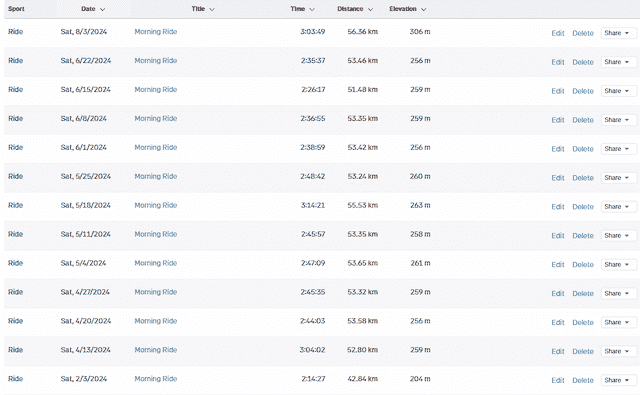
Recently, I began thinking of starting a new personal project based on the data I have, around 400 activities. Stray files are difficult to query, and since I have been meaning to explore spatial databases and quadtrees, this feels like the perfect opportunity to dive in. While tracking apps show a bit of analytics, they don’t always track the idiosyncratic details that matter to me, like exactly how many hours of my life have been swallowed by red lights.
While everyone around me was using Strava to stay connected, I remained hesitant, skeptical of the privacy implications inherent in such platforms. Eventually, I realized I could obfuscate my data before it ever touched their servers, which gave me the confidence to finally give it a try. If you are over there, let's connect!
It helped that I was only tracking GPS coordinates rather than intimate health metrics like heart rate. My workflow for anonymizing my rides became a bit of a digital ritual: I track with Fitotrack, export the data as GPX, and then anonymize the data by carefully trimming the start and end points, ensuring my front door remains off the map, and offsetting the timestamps. This allows me to preserve the integrity of my speed and distance data. If they ever sell my data, I wish the advertisers good luck figuring out why I seem to commute to work at midnight and arrive home before I even leave.
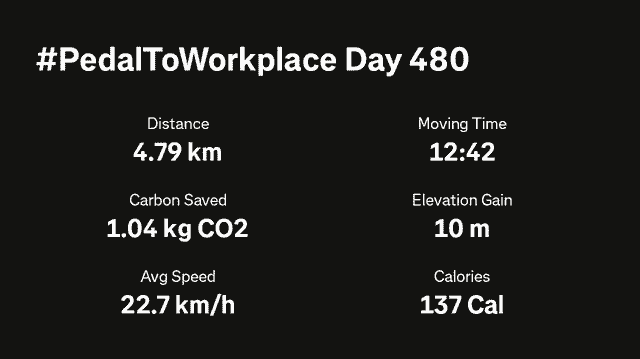
One feature I love about Strava is that if you tag an activity as a “commute,” it shows your “carbon saved.” This was a major inspiration for this article. Each day, my two activities show a saving of about 1 to 1.25 kilograms of carbon each. Over 500 days, those small increments have added up to over 1,000 kilograms. That is over a ton of carbon saved, literally.
The Invisible Footprint
Seeing that cumulative impact was a revelation for me; it shifted my perspective towards the carbon footprint we leave behind in the digital realm. In computing, software is a collection of processes, and processes are sets of instructions for the CPU. In a typical consumer PC, hundreds of these may be running at once.
The first law of thermodynamics tells us that energy can neither be created nor destroyed; it can only be transformed. The heat radiating from your device is physical evidence of this energy conversion, known as processor power dissipation, a byproduct of millions of instructions. Electrical energy converts to thermal energy. Since much of our electricity still comes from coal, every CPU instruction carries a carbon footprint. When scaled across millions of instructions and billions of devices, this invisible energy consumption transforms into a staggering global footprint.
This invisible footprint only grows heavier with the rise of AI. As the race for AI dominance continues, the energy demands for data centers are skyrocketing. We often treat these machines with a human touch, adding a polite “please” or “thank you” to our prompts. Here, however, this digital etiquette carries a measurable cost in current and coal. Every unnecessary word extends the sequence the model must process, multiplying the computational workload and siphoning more power. These embeddings propagate through massive matrices, cascading into billions of invisible GPU instructions.
For those curious about the staggering arithmetic of AI energy use, here’s a quick one-minute read: The Hidden Behemoth Behind Every AI Answer or a more detailed one: We did the math on AI’s energy footprint. Here’s the story you haven’t heard.
Our operating systems also play a role. Windows, for instance, is built on heavy, power-hungry decisions. Back in 2025, Windows 11 was run by over 1.4 billion users monthly and that number has only grown. In the background of these billions of PCs, countless processes, particularly newer AI integrations, run constantly despite offering little value to the average user. Fortunately, Microsoft is beginning to reevaluate their "AI" integrations. Furthermore, a great deal of software now chooses to launch at startup, as background processes, just to appear faster when you eventually open them. Microsoft's Office is a prime example. If you are a Windows user, I recommend visiting your startup tab in the task manager and disabling anything unnecessary. Tools like Win11Debloat can also help by removing pre-installed bloatware and disabling telemetry, saving a bit of power with every boot.
Finally, we must look at the web itself. Many modern websites have become a bloated mess, shipping entire applications just to ensure smooth transitions between pages. These heavy JavaScript bundles require significant CPU work to render. While people often blame browsers like Chrome for high memory usage, the real culprits are often the websites themselves. Most browsers now offer an energy saving mode that puts inactive tabs to sleep; I highly recommend turning it on. But there is still hope. There are still pockets of the internet where websites are small and designed to last. These sites celebrate the "beautiful small web", acting as an inspiration for the few who care. In an era of “vibe-coding” and framework-heavy AI generation, this mindset is more important than ever.
Conclusion
I started this journey three years ago with a simple five-kilometer commute and a point to prove. But as the kilometers turned into a ton of carbon saved, I realized that the real victory wasn’t in proving a point. It was in the quiet consistency of showing up day after day. We don’t all have to pedal to work to make an impact; sometimes, we just need to be mindful of the choices we make every day. Whether it is choosing a simple web search over an AI prompt or writing code with its carbon footprint in mind, the care we put into such small things is what eventually makes the biggest difference!